Marseille dared to challenge PSG but the empire has struck back in style
To understand Marseille’s season, you need not watch all of their games; those played against PSG will suffice. After Marseille’s 1-0 win over the European champions in September – their first at the Vélodrome in the league in 14 years – the word “finally” was the word scrawled across the front page of local paper La Provence. That victory brought relief, but also hope and optimism: the Empire could be toppled. But it struck back on Sunday night.
A Complicated Situation In Paris
Paris FC: Challenging the status quo in the French capital
Paris is not only a cultural hub in Europe but it’s also a hub for sporting talent.
FotMob - March 18, 2025, 6:36 AM
By Ben Bocsák
It’s on the streets of Paris where some of the finest footballers of the modern generation had learned their trades.
At the 2022 Qatar World Cup, nine different national teams had at least one player in their squad who was born in Paris. The French national team had 11.
When it comes to football clubs, Paris Saint Germain is the dominant team in the region. They have won eight league titles in the last decade and continue to attract some of the world’s biggest stars.
Their status at the pinnacle of French football looks uncontested at the moment but a noisy ‘neighbour’ in Paris FC is looking to knock them off their perch in the near future.
For a short period of time Paris FC and Paris Saint Germain had been one and the same after a merger in the 1970s. But this was short-lived. A bitter split occurred in 1972 when Paris’ mayor had an issue with the club being situated in the suburbs of Paris in Saint Germain-en-Laye.
The results of this saw Paris FC remain its status in the first division and hosting matches in the Parc des Princes meanwhile Paris Saint Germain were relegated to the third division.
This would prove to be bittersweet for the former. Paris FC struggled to maintain their competitiveness in the top-flight and were relegated just two seasons after the split. Coincidentally, the same season Paris FC were relegated, Paris Saint Germain were promoted to the top-flight having been buoyed by a new drive and determination to get back to ‘where they belong.’
Ultimately, this saw Paris Saint Germain reseize the Parc des Princes and their status as Paris’ ‘top’ football club.
Meanwhile, Paris FC have been cast into the shadows ever since. A brief foray in the top-flight offered some hope in the 1979/80 season but they were immediately relegated back to Ligue 2.
The subsequent decades have brought little hope for Paris FC. The club has spent most of the 1980s and 1990s in the third and fourth divisions of France playing in semi-professional and amateur leagues.
Since the 2000s though, Paris FC have started to emerge as a force again by investing in young players.
Instead of focusing on the first team, Paris FC has built one of the best developmental academies in France, harnessing the talent of the city.
Over the last decade Paris FC has produced the likes of Ibrahima Konaté, Rayan Aït-Nouri, Mathys Tel, Manu Koné, Loïc Badé, Axel Disasi and Nordi Mukiele who have all gone on to play at the very highest level of the game.
The money brought in through development transfer fees has given Paris FC a new resurgence.
In 2014/15, the club earned promotion back to Ligue 2 and have remained there ever since and this season they look to return back to the top flight since 1980.
But it’s off the pitch where the most interesting changes have occurred.
Earlier this season France’s wealthiest man Bernard Arnault bought a majority 52.4% stake in the club. He is the CEO of LVMH and has an estimated net worth of $170.8 billion according to Forbes. Alongside him, minority investors Red Bull have also put a 10.6% stake in the club and have added Paris FC to their extensive portfolio that includes the likes of RB Leipzig, Red Bull Salzburg and New York Red Bulls.
Red Bull’s football CEO, Jürgen Klopp, is also involved in the project and he has recently been spotted attending games in Paris.
Together the investment group has set some lofty ambitions.
In the press conference announcing his acquisition of the club last year Arnault even opened the doors to Paris FC bringing back former player Ibrahima Konaté in the future.
When asked about the possibility, he replied:
“The idea is to train young people, then, if a former member of the club’s training team wants to come and form the backbone of the club, why not?
“It’s a possibility, but not the group’s basic strategy.”
Since then, Paris FC have also announced that from next season the club will be in very close proximity to Paris Saint Germain.
They will be moving to the Stade Jean-Bouin, currently being used by the Stade Francais rugby team which is literally just across the street from Paris Saint Germain’s home of the Parc des Princes.
With the club currently in third place in Ligue 2, just one point off an automatic promotion place, there is a strong possibility Paris FC will return to Ligue 1 after a long hiatus.
They are playing some attractive football, averaging the fourth highest goals (1.6) and the most possession (60.8%) in the league.
But while the signs are promising, these are early days at Paris FC. At the moment only three teams have an older average squad age in Ligue 2 than Paris FC. This is the antithesis of the club’s future vision. With Red Bull involved and strong academy foundations in place, Paris FC will look to build a young team in the same mould as RB Leipzig or Red Bull Salzburg or perhaps even closer to home – the current Paris Saint Germain team.
The ultimately goal is to become a true contender again and to reignite a fierce rivalry that has been dormant in the shadows for decades. If successful, Paris FC can challenge Paris Saint Germain’s hegemony and completely transform the landscape of French football.
These are lofty ambitions but with Arnault, Red Bull and Klopp involved – anything is possible.
Lens, the brilliant and ‘normal’ team who pushed Messi and PSG all the way: Special report
The full-time whistle blows… but nobody is going anywhere. This party started early, and will not finish before the day is out.
Yellow and red shirts have been filtering into the small city of Lens, in that far northern corner of France between Paris and the sea, throughout the day and at 5pm, the town square is packed with supporters as they prepare to make their way to Stade Bollaert-Delelis, an old-school, British-style stadium with four terraces and a 38,000 capacity greater than the population of Lens itself.
Inside, the crowd are buoyant, ready to serenade their players and later, belt out the chants of “On les a chicote” (We have rattled them) and Pierre Bachelet’s Les Corons, a hymn for the coal miners of northern France that is now the club’s anthem. Football dominates in these parts and is now entwined with the city’s identity; the stadium holds the same presence in the skyline as the slag-heaps of mining waste that tower overhead, looming pyramids that are echoes of an industrial past.
Saturday’s 3-0 home win over already-relegated Ajaccio leads to fireworks and Champagne. After soaking the waiting media in the mixed zone after the game, defender Jonathan Gradit calls the night a high point of his career.
“It (the Champions League) is Real, it’s Bayern, it’s a monumental party and once again it’s a reward for everything we’ve been able to do,” Gradit says. “This is our own reward. There were emotional tears because we’ve been together for more or less three years and frankly what we’re going through is great.”
There is joy at Racing Club de Lens, to use their full name, and it has been a long time coming.
After a wait of 20 years, they have qualified for the Champions League again. By finishing second in Ligue 1, they will go straight into the group stage with title winners Paris Saint-Germain.
It resonates.
As recently as September 2017, Lens were bottom of Ligue 2, the French second tier. They had recently avoided bankruptcy for the second time in a decade and some fans got inside their training complex, La Gaillette, to voice their dissent.
Three years later, they were promoted. Three years on from that, they are dusting off their passports.
“From the first year back into Ligue 1, there was something about this team, there was something about this coach,” the club’s owner, and president, Joseph Oughourlian, tells The Athletic. “The atmosphere at the Stade Bollaert was unbelievable. It’s not just the town, it’s the region’s club.
“There has been this wait for the club to do better. Returning to Ligue 1 was a big step. But this year, the team has really surpassed any expectations, any fan expectations, any rational person’s expectations. It’s all come together.
“It has been great, and a lot of fun.”
Four hours before kick-off on Saturday, Oughourlian is sitting in the calm setting of the Louvre hotel. The team are here too, sitting near the foyer and going through final pre-match routines.
Oughourlian, who first became a shareholder at Lens in 2016 and took full control five years ago, suits this environment. It’s quieter, more sedate, for an owner who says he prefers to stay out of the limelight.
He is from a different world compared to the city of Lens and the terraces of the Stade Bollaert. Born in Paris, 110 miles (179km) to the south, he became a financier and founded the hedge fund Amber Capital in 2005. The firm operated from New York before relocating in 2012 to London (less than 150 miles away as the crow flies), where he too is now based.
The link to Lens? “There was no connection,” Oughourlian says. “It was a pure fluke.”
Chance perhaps but for Lens, it may be considered fortunate.
Twice in the past decade, as mentioned above, they have essentially gone bust, most recently in 2016 after two years where Azerbaijani businessman Hafiz Mammadov, who took full control three years earlier, stopped investing in the club. Oughourlian was initially brought in as an investor alongside La Liga heavyweights Atletico Madrid, who in turn wanted to buy into the club to help Mammadov.
“I said, ‘As long as you manage it, because I can’t manage a football club, I’d say yes’,” Oughourlian says. Ultimately, he became the majority shareholder.
“(Mammadov) did not show up,” Oughourlian says. “So I did all the financial engineering around buying the club and then found myself owning a majority and then essentially naming the management. They (Atletico) lost interest. Eventually, I became chairman (in 2018). I wasn’t expecting to buy the club and take control and become chairman.”
It was a difficult time to take over.
Lens had won Ligue 1 for the only time in their history in 1998 and qualified for the Champions League again four years later. But since then, European tours became infrequent. They were relegated in 2008 and though they bounced back to the top flight immediately, by then the rot had set in. Between 2011-12 and 2020-21 they spent just one season in Ligue 1, finishing bottom in 2015.
“It was a club that was still living in its past,” Oughourlian says. “A great club that had fallen behind — a Sunderland, where there’s still a lot of popular affection, a brand name, titles, stories. It’s a bit of a lethal combination, to be honest. They still thought of themselves as a big, amazing club. But they were in Ligue 2.
“From that perspective, I was quite lucky to have arrived after a very very long period (of difficulty). They were ready to make sacrifices and that’s what we asked of them.”
Oughourlian made cuts, pointing to the club employing “more than 80 people” despite being in the second tier. He appointed people with the know-how he did not possess, such as Arnaud Pouille, who was general manager and is now chief executive. “You have to surround yourself with people that have that experience,” Oughourlian says. “It’s not something you can improvise, or learn from doing.”
Then, in 2017, with the club struggling on the field, Oughourlian organised a seminar with key stakeholders, including fans, staff and the players.
“I asked, ‘What do you think our core values are? What do we stand for? Who are we?’. I listened. I’m not from the region. I wasn’t a fan of Lens. I didn’t follow the club. When you live in London, you’re a financier, you’ve come from New York, you’re not going to arrive at Lens and say, ‘These are your values’. What do I know?!
“We defined our values, what we stood for. We put them on our walls, and told them to the first team and across the club, from the youngest players to the staff. It was nothing shocking — passion, being respectful. It was important to have gone through that stage. You set the foundations for the club to succeed… hopefully.”
There was a resetting of club culture. Club jackets were introduced into the boardroom. On Saturday night, the players were all awarded miners’ lamps as an end-of-season memento.
“You can still have a strong local culture, as part of a particular region, and still it resonates with the rest of the country and it resonates with people outside of the country,” Oughourlian says. “Because it’s all about our values. They are mining values, but they fit well with sports. It’s community. Teamwork.”
Constant improvement followed on the field.
After the nadir of 2017-18, where they finished 14th in the 20-team second tier, losing over half their 38 games, Lens improved to reach the promotion play-offs the following season, where they were defeated by top-flight Dijon in the final. They went up automatically in pandemic-curtailed 2019-20 (Lens were second when the season was halted with 10 matches to play and later abandoned), and once in Ligue 1 again continued to thrive.
In their first season up, Lens finished an impressive seventh with 57 points (Rennes qualified for Europe with 58). They improved in 2021-22 with 62 points as they came seventh again. And now they already have 81 with one game still to play.
That they have pushed serial champions PSG all the way, even though the Parisians’ annual budget is said to be 10 times greater than theirs, is astonishing.
“We’re very ambitious, but at the same time, we’re very normal people,” Oughourlian says. “In some ways, we’re not like PSG. We’re not an all-star team. It’s a team effort.
“That’s not criticising PSG. I think they’ve been incredibly successful — contrary to what people may think because they’ve had a difficult season in the Champions League. But aside from that, we’re just the opposite. They are a global brand. We’re a local brand. They appeal to stars. Our values are collective, teamwork, there’s no one big star in our team.
“It (PSG) is the club of a rich and wealthy area. I’m not saying they do not have humble fans, they have so many different fans. But they are in the capital, and we’re the poorest region in France.”
Success has continued despite considerable challenges.
Key players have been poached. Last summer, Lens lost their top 2021-22 goalscorer Arnaud Kalimuendo, who had been on loan from PSG and was then sold to Rennes for €20million (£17.3m; $21.4m at current exchange rates). Full-back Jonathan Clauss, a beloved figure, went to Marseille for a reported €9m while midfielder Cheick Doucoure went to Crystal Palace of the Premier League in a deal worth up to €26m.
Clauss left Lens for Marseille last summer (Photo: Catherine Steenkeste/Getty Images)
“If one of the big clubs in France or from the Premier League wants someone, they will get them,” admits Oughourlian. “Clauss went to Marseille. We thought of him as one of our key players. We discovered him in the second division in Germany. Marseille wanted him and could triple or quadruple his salary. There’s nothing we could do at that point.
“As much as we like the player and the player likes us, you have to be reasonable. You have to understand who you are and where you are.”
That impacts staff, too. Florent Ghisolfi, the club’s former sporting director, was seen as an integral part of their impressive recruitment programme. He was poached by fellow Ligue 1 side Nice last October.
“You have to make sure that there’s always a Plan B,” Oughourlian says. “That you react very quickly. One of our key assets is a very lean chain of command. It’s my CEO (Pouille), his sports director (Gregory Thil), the manager (Franck Haise), and myself. It’s two phone calls away from: ‘Yes, no, what do we do, who do we hire?’ I’m an hour and a half away in London. I can be here very, very quickly. We can react very quickly, which is what we’ve done so far.”
Those players who left last summer have not been missed.
Kalimuendo was replaced by Lois Openda, signed from Belgium’s Club Bruges for about half the fee Rennes paid PSG for his predecessor. The 23-year-old Belgian international has 20 league goals so far and, against Ajaccio, equalled Roger Boli’s club scoring record for a single Ligue 1 season.
Clauss, a right wing-back, was replaced first by Jimmy Cabot, signed from Ligue 1’s Angers, but after the newcomer suffered a season-ending knee injury in October the club adapted by re-positioning Przemyslaw Frankowski, who has played on the left for them and for Poland, with Deiver Machado stepping in on that flank. Machado has had a difficult first season as a regular starter, but was on the scoresheet in Saturday’s vital win.
In central midfield, Salis Abdul Samed arrived from Clermont to replace Doucoure and his presence has ensured Seko Fofana has continued to thrive.
On the staffing front, Ghisolfi was replaced by Thil, who had been his deputy. And promoting internally has brought rewards.
“It’s something I have done in business,” Oughourlian says. “I like to promote people. In business in general, people like to think the grass is greener somewhere. But you always have talent at home if you look around and if you’re a bit patient. Let them thrive, give them the means to thrive. That’s very important.”
The best promotion the club have made, without doubt, was Haise from B-team manager to the first-team job. His appointment, replacing Philippe Montanier in February 2020, was his first senior role in management. As a player, his career was mainly confined to France’s lower divisions, before moving through various coaching posts and eventually joining Lens in the summer of 2017, having been an assistant and (briefly the previous season) caretaker manager at Lorient.
“Franck embodies the values of our club,” says Oughourlian. “We wanted to promote him because he had done a very good job with our B team. It was important to create a bridge between the local talent and the first team. That’s still part of our ambition, to promote youth.”
Haise was this week named Ligue 1 coach of the year (Photo: Bertrand Guay/AFP via Getty Images)
Haise has been the driving force behind the team. They have channelled the energy cultivated at the Bollaert into their style of play, a variation of a 3-4-3. But it is getting the most out of the available talent that makes the 52-year-old stand out.
There are jewels in the team; Fofana is the engine of their success, a complete midfielder who can dominate in both boxes, while Openda has shown an impressive eye for goal. Kevin Danso, a central defender who spent the 2019-20 season with Southampton, has finally found his footing under Haise while Brice Samba, who was key to Nottingham Forest winning Premier League promotion last May, was named Ligue 1 goalkeeper of the year this weekend.
But this is a team built on a collective spirit and that is typified by those who have progressed with the club.
Gradit, a smart central defender, was a part of the 2019-20 promotion-winning side and is now holding his own in the top flight at age 30. A decade ago, he was playing amateur football after a blood infection left him in intensive care, which took a year out of his career and scuppered his hopes of breaking through at Bordeaux. After five years with Ligue 2 side Tours, he got released, had a season with top-flight Caen, then moved to Lens in the summer of 2019.
Florian Sotoca has a similar story. The versatile 32-year-old has mainly featured in an attacking role playing behind the striker, and has scored seven goals and provided nine assists in Ligue 1 this year. He was also playing amateur football as recently as 2013, while working with his uncle, a wholesaler who resold shoes, to pay the bills.
“There are a group of players who experienced Ligue 2, that COVID-19 season, but today what we are experiencing is quite extraordinary,” Sotoca told the media after the Ajaccio game, standing alongside Gradit and soaked in Champagne. “We work a lot, we have benchmarks, we have never given up, even those who have not played a lot, they have always been there. ”
All of this has been achieved in union with the fans.
The ultras at the Bollaert are situated in the Marek-Xerxes Stand, which is not behind the goal as in so many cases, such as Anfield’s Kop, but runs alongside the pitch. The atmosphere is electric and unique. Last August, after a summer of speculation, Fofana signed a new contract there in front of 37,161 people after a 5-2 win over Lorient.
Following matches, the players have gone over to the Marek to share the victory with their supporters and sing On Les A Chicote, with a player leading the chant. Haise himself was the frontman after they beat PSG 3-1 on New Year’s Day, ending the Parisians’ 23-match unbeaten run in all competitions to start this season.
Lens have an exceptional home record this season of 17 wins, one draw and one defeat. It’s the best in Ligue 1. Those results speak for themselves.
French clubs that poke the PSG bear often find that their star talents are whisked away in the season that follows. It was the fate that met Monaco after their title triumph in 2016-17, and also Lens’ neighbours Lille after they were champions two years ago.
The vultures are circling again.
Haise has been linked with a Premier League move and with Marseille. Openda has caught the eye of AC Milan. Danso and Fofana, who have made the Ligue 1 team of the season with colleagues Openda and Samba, are expected to have suitors, too.
For Oughourlian, it is inevitable.
“You try and anticipate it as much as you can,” he says. “First, no one is irreplaceable — especially at Lens, as it’s a team effort. That’s part of business, of sport. You’re going to lose key players. Key staff. We might lose some key players (this summer), and that’s fine. The chance is lower (now they are) in the Champions League, players may hesitate before leaving. The Premier League could approach any player and may have a shot.
“But there is a good counterexample to that — Brice Samba, our goalkeeper who was with Nottingham Forest. They were promoted last season into the Premier League and we convinced him to come play for us. The reason is very simple. It’s the Spanish saying: ‘Would you rather be the head of the mouse or would you rather be the tail of the lion?’ What’s more interesting for you? To be avoiding relegation in the EPL or to be playing for Europe?’
“But if a bigger club came for our players, a top-10 Premier League club, it would be hard to resist. Financially, we couldn’t.”
Competing with the biggest teams consistently will be a challenge. But Oughourlian looks at examples around Europe of teams with smaller budgets who have found a way to thrive, such as Brighton, Brentford, Villarreal and Atalanta.
He speaks positively about Lens’ youth set-up too. The training ground, La Gaillette, which was opened in 2002, has nurtured talents including Raphael Varane, Serge Aurier, Thorgan Hazard and Geoffrey Kondogbia.
Varane (right), now at Manchester United, came through at Lens (Photo: Kenzo Tribouillard/AFP via Getty Images)
“You just have to be smarter,” Oughourlian says. “Lean and mean. Which is the same in any business. There’s always an 800-pound gorilla, but the smaller guys still exist too. There are 17 other teams PSG will need to play against.
“The difficulty is always the same (for clubs such as Brighton and Villarreal) — to maintain your position and not go up the stairs to fall down the elevator shaft. The key for us is to remain agile, disciplined and careful, because, for us, a mistake can be lethal. Whereas a PSG can make more mistakes and weather them.”
Budget-wise, returning to the Champions League will be transformative.
Oughourlian started at Lens with a €17million budget in Ligue 2. Next season, that will rise to €120million. He is conscious of not raising expectations too high. “We’re the underdogs; yes, in the Champions League but even in the French league, trying to make the top six,” he says. “Our budget this year was around 12th, or around one off that. That we finished second is surprising, and remarkable.
“We also have a commitment to the local people that the price of tickets will remain affordable. We have to be very careful to control prices.”
He is open to outside investment and says he has been talking to possible new partners and has been approached. But he is cautious.
“It’s a special place, Lens,” he says. “PSG is the company of the world. It’s owned by Qatar, it’s Paris. It’s international. It’s a natural thing for them for an American or Middle Eastern investor to come in. Here, you have to be careful about who you bring in. That it’s not just a question of money. It’s also a question of finding the right partner.”
Oughourlian is also the majority owner of Padova, in Italy’s third division, while he has invested in Millonarios of Bogota in Colombia’s top division, and Real Zaragoza, in Spain’s second tier, where he is a minority shareholder. Those stakes are not seen as being parts of a multi-club-model framework, which is not on the cards for Lens.
“If I sold Lens to Arsenal or Chelsea, that would make sense for them,” he says. “They could centralise French talent, train them. But Lens would be a feeder club. No interest to play in Europe. That would be damaging for our fans.”
While challenges again await off the field, the Champions League will return to the Bollaert this September. Its iconic anthem boomed around the ground on Saturday night to a rapturous ovation, the excitement palpable not only on the terraces but out on the pitch too.
“(The Champions League) is the result of all the work, of all the sacrifices,” said Samba after the game. “Everyone is rewarded, individuals also stand out, and everyone has put their stone in the building (the team has built). We can only be proud. For me, it is pride. When I arrived here, it was to put Lens back as high as possible.”
And for the club president who has helped to make it all happen, have this northern club got under his skin?
“Definitely,” Oughourlian says. “Especially after six years where it’s not all been easy. In football, there’s always an element of hazard, so when the going gets good, you better make the most of it. Enjoy the moment.”
On Saturday’s evidence, that seems to be the case in Lens.
Paris Saint-Germain: 2022 Trophee des Champions Winners
Messi stars as PSG beat Nantes in Trophée des Champions
Publish on 31/07/2022 at 21:54 - S. TELFORD
Lionel Messi, Neymar Jr. and Sergio Ramos were on target as Paris Saint-Germain beat FC Nantes 4-0 in to lift the Trophée des Champions in Israel.
Paris Saint-Germain 4-0 FC Nantes
THE MATCH
PSG were without suspended superstar Kylian Mbappé for this meeting at Tel Aviv's Bloomfield Stadium, but Christophe Galtier packed enough talent into what looks to be becoming his preferred 3-4-1-2 formation. Achraf Hakimi had the first chance of the game early on after neat interplay in the Nantes box, but his shot was well saved by Alban Lafont (5'). Marquinhos then rattled Lafont's crossbar with a header following a Messi corner as les Canaris held on (14'). Nantes looked capable of hitting PSG on the break, and Gigi Donnarumma had to be on his toes to keep a curling Ludovic Blas attempt out from the edge of the area (19'). Paris took charge of the game soon after, though, with Messi sitting Lafont down with his left foot before firing high into his goal with his right (22'). Neymar then shaved the far post before the flag went up for offside against him (40'), but he found the target in first half injury-time, steering home a fine free-kick for 2-0 (45+5').
PSG pull clear
Evann Guessand (50') and Messi (53') exchanged chances before Ramos made it 3-0 inside the hour. Pablo Sarabia forced a save from Lafont and Ramos reacted quickest, bagging his 130th career goal an exquisite backheel - not bad for a centre-back (59')! Former PSG coach Antoine Kombouaré tried to change things up, sending Samuel Moutoussamy and new arrival Mostafa Mohamed into the fray (64') and switching to a 4-2-3-1 system having initially mirrored PSG's three-man defence, but damage minimalisation was all Nantes had left in them. Juan Bernat - who had himself come on for Nuno Mendes (68') - fired into the outside side-netting after being slipped through by Neymar (77'). Nordi Mukiele then replaced Hakimi, coming on for his PSG debut having joined this week from RB Leipzig (78') before Neymar made it four from the penalty spot (82') - Jean-Charles Castelletto sent off for the challenge on the Brazilian that led to the spot-kick. Lafont denied Messi a second late on (88') and it ended 4-0.
THE PLAYER: Lionel Messi
Messi was criticised last year during his maiden campaign in France after scoring just six Ligue 1 Uber eats goals, but he was quick to post photographs of his pre-season training regimen to his Instagram this summer, and he contributed two goals and an assist in PSG's recent friendly tour of Japan. The Argentine picked up where he left off here, orchestrating Paris's play throughout and was rewarded with his 32nd goal in a final.
THE STAT: 11
PSG have now won the Trophée des Champions a record 11 times - three more than next-best Olympique Lyonnais. Sunday's triumph was their first in two seasons, however, having lost to Galtier's previous employers LOSC in 2021 showpiece - although Jocelyn Gourvennec was les Dogues' coach by the time the sides met in Tel Aviv.
In Lionel Messi’s Move, a Dim Portrait of Modern Soccer
He could not stay where he wanted; few teams could afford him. Even one of the best players of all time was not able to resist the economic forces that carry the game along.
By Rory Smith
Aug. 10, 2021
In those frantic, final hours in April, before a cabal of owners of Europe’s grandest clubs unveiled their plan for a breakaway superleague to an unsuspecting and unwelcoming world, a schism emerged in their ranks.
One faction, driven by Andrea Agnelli, chairman of Juventus, and Florentino Pérez, president of Real Madrid, wanted to go public as quickly as possible. Agnelli, in particular, was feeling the personal pressure of acting, in effect, as a double agent. Everything, they said, was ready; or at least as ready as it needed to be.
Another group, centered on the American ownership groups that control England’s traditional giants, counseled caution. The plans still had to be finessed. There was still debate, for example, on how many spots might be handed over to teams that had qualified for the competition. They felt it better to wait until summer.
If the first group had not won the day — if the whole project had not exploded into existence and collapsed in ignominy in 48 tumultuous hours — this would have been the week, after the Olympics but before the new season began, when they presented their self-serving, elitist vision of soccer’s future.
That the Super League fell apart, of course, was a blessed relief. That this week has, instead, been given over to a dystopian illustration of where, exactly, soccer stands suggests that no great solace should be found in its failure.
On Thursday, Manchester City broke the British transfer record — paying Aston Villa $138 million for Jack Grealish — for what may not be the last time this summer. The club remains hopeful of adding Harry Kane, talisman of Tottenham and captain of England, for a fee that could rise as high as $200 million.
And then, of course, dwarfing everything else, it emerged that Lionel Messi would be leaving — would have to leave — F.C. Barcelona. Under La Liga’s rules, the club’s finances are such that it could not physically, fiscally, register the greatest player of all time for the coming season. It had no choice but to let him go. He had no choice but to leave.
Everything that has played out since has felt so shocking as to be surreal, but so predictable as to be inevitable.
There was the tear-stained news conference, in which Messi revealed he had volunteered to accept a 50 percent pay cut to stay at the club he has called home since he was 13, where he scored 672 goals in 778 games, where he broke every record there was to break, won everything there was to win and forged a legend that may never be matched.
As soon as that was over, there came the first wisps of smoke from Paris, suggesting the identity of Messi’s new home. Paris St.-Germain was, apparently, crunching the numbers. Messi had been in touch with Neymar, his old compadre, to talk things through. He had called Mauricio Pochettino, the manager, to get an idea of how it might work. P.S.G. was in touch with Jorge, his agent and father.
Then, on Tuesday, it happened. Everything was agreed upon: a salary worth $41 million a year, basic, over two years, with an option for a third. As his image was stripped from Camp Nou, a hole appearing between the vast posters of Gerard Piqué and Antoine Griezmann, Messi and his wife, Antonela Roccuzzo, boarded a plane in Barcelona, all packed and ready to go.
Jorge Messi assured reporters at the airport that the deal was done. P.S.G. teased it with a tweet. Messi landed at Le Bourget airport, near Paris, wearing that shy smile and a T-shirt reading: “Ici, C’est Paris.”
This was not a journey many had ever envisaged him making. But he had no other choice; or, rather, the player for whom anything has always been possible, for once, had only a narrow suite of options.
There is a portrait of modern soccer in that restricted choice, and it is a stark one. Lionel Messi, the best of all time, does not have true agency over where he plays his final few years. Even he was not able to resist the economic forces that carry the game along.
He could not stay where he wanted to stay, at Barcelona, because the club has walked, headlong, into financial ruin. A mixture of the incompetence of its executives and the hubris of the institution is largely responsible for that, but not wholly.
The club has spent vastly and poorly in recent years, of course. It has squandered the legacy that Messi had done so much to construct. But it has done so in a context in which it was asked and expected to compete with clubs backed not just by oligarchs and billionaires but by whole nation states, their ambitions unchecked and their spending unrestricted.
The coronavirus pandemic accelerated the onset of calamity, and so Barcelona was no longer in a position where it could keep even a player who wanted to stay. When it came time for him to leave, he found a landscape in which only a handful of clubs — nine at most — could offer the prospect of allowing him to compete for another Champions League trophy. They had long since left everybody else behind, relegated them to second-class status.
And of those, only three could even come close to taking on a salary as deservedly gargantuan as his. He should not be begrudged a desire to be paid his worth. He is the finest exponent of his art in history. It would be churlish to demand that he should do it on the cheap, as though it is his duty to entertain us. It could only have been Chelsea or Manchester City or Paris.
To some — and not just those who hold P.S.G. close to their hearts — that will be an appetizing prospect: a chance to see Messi not just reunited with Neymar, but aligned for the first time with Kylian Mbappé, who many assume will eventually take his crown as the best, and with his old enemy Sergio Ramos, too.
That it will be captivating is not in doubt. And doubtless profitable: The jerseys will fly off the shelves; the sponsorships will roll in; the TV ratings will rise, too, perhaps lifting all of French soccer with it. It may well be successful, on the field; it will doubtless be good to watch. But that is no measure. So, too, is the sinking of a ship.
That the architects of the Super League arrived, in April, at the wrong answer is not in doubt. The vision of soccer’s future that they put forward was one that benefited them and left everyone else, in effect, to burn.
But the question that prompted it was the right one. The vast majority of those dozen teams knew that the game in its current form was not sustainable. The costs were too high, the risks too great. The arms race that they were locked into led only to destruction. They recognized the need for change, even if their desperation and self-interest meant they could not identify what form that change should take.
They worried that they could not compete with the power and the wealth of the two or three clubs that are not subject to the same rules as everybody else. They felt that the playing field was no longer level. They believed that, sooner or later, first the players and then the trophies would coalesce around P.S.G., Chelsea and Manchester City.
It was sooner, as it turns out. P.S.G. has signed Messi. City may commit more than $300 million on just two players in a matter of weeks, as the rest of the game comes to terms with the impact of the pandemic. Chelsea has spent $140 million on a striker, too. This is the week when all their fears, all their dire predictions, have come to pass.
There should be no sympathy, of course. Those same clubs did not care at all about competitive balance while the imbalances suited them. Nothing has damaged the chances of meaningful change more than their abortive attempt to corral as much of the game’s wealth as possible to their own ends.
But they are not the only ones to lose in this situation. In April, in those whirlwind 48 hours, it felt like soccer avoided a grim vision of its future. As Messi touched down on the ground near Paris on Tuesday, as the surreal and the inevitable collided, it was hard to ignore the feeling that it had merely traded it for another.
Rory Smith is the chief soccer correspondent, based in Manchester, England. He covers all aspects of European soccer and has reported from three World Cups, the Olympics, and numerous European tournaments. @RorySmith
PSG ended Champions League curse vs. Dortmund. Only time will tell if they get to keep going
Julien Laurens
Correspondent
ESPN
It was a seismic event in an empty stadium as the biggest Paris Saint-Germain victory of the season to date was celebrated in almost complete silence. Yet some of the players swear that, when Anthony Taylor blew the whistle for full-time, confirming PSG's place in the Champions League quarterfinals and eliminating Borussia Dortmund, they could hear the thousands of fans gathered outside the Parc des Princes while they left the pitch inside.
Wednesday night's 2-0 win happened behind closed doors, but all through the mild Parisian night, the doors had been open a little bit. The ultras, congregating outside, demonstrated what it meant to love a football club. They were a constant presence before, during and after the game, singing, chanting and lighting red flares in celebration.
They had good reason to celebrate, too. The victory was significant given that the pressure on PSG was high, the stakes enormous and the emotional release at full-time so huge. PSG, Thomas Tuchel, the Qatar royal family that owns the club, Neymar, Kylian Mbappe, you name it: They would not be knocked out again at this stage of the competition like they were in the past three seasons. Repeating that heartbreak would have surely signified the end of Tuchel as manager and probably the end of the "Neymappe" cycle, too. Another early humiliation would have very possibly meant their collective departure in the summer.
The reputation of being the team that bottles the big occasions after two remontada home and away in the past three years was starting to follow them around. The curse of the Champions League, with all those dramatic premature exits, was starting to be too heavy to carry. On top of all of that, they had to play in an empty stadium and with Mbappe on the bench, having barely recovered from a nasty case of flu and a precautionary coronavirus test that came out negative the day before the game.
With all the narratives swirling around the match, they still came out with a performance none of their fans (or critics) had seen this season. They played as a team, something no one really thought they could pull off. They defended together, pressing and counterpressing together. It was a display full of heart, guts and talent. They were disciplined, well-organised, aggressive. It was a controlled victory, not a thing you normally say about PSG, particularly not this season.
One player epitomised their efforts. Neymar is, without doubt, a divisive player. He is loved and disliked around the world in equal. He did troll Erling Haaland with his goal celebration after the Norwegian international kicked off the banter on social media earlier in the day. Dortmund as a club had actually been quite vocal on social media after their 2-1 first leg win, with the likes of Axel Witsel, Emre Can, Haaland, the club's official Twitter account and even former player (and Champions League winner) Lars Ricken all having a go at PSG.
"We felt that [Dortmund] lost their humility after the first leg. After their win, they put out a lot of tweets, Instagram posts -- a lot of words. We all saw it and kept it in the back of our heads and I think it boosted us. We had a bit of anger in our minds," Presnel Kimpembe said after the match on Wednesday.
The roles were reversed compared to last season's elimination, in which PSG were not humble enough before their ill-fated game against Manchester United at home. But the players learned their lesson this time around, with Neymar setting the tone and playing like a leader. He scored the first goal and began the move for the second one. For the Brazil international, who missed the previous two crucial round-of-16 Champions League second legs through injury and failed to get his move back to Barcelona in the summer, the qualification felt like a liberation.
Before the communion with the fans from one of the Parc des Princes' elevated passageways, Neymar had a moment to himself and cried. Like his teammates, he knows that there is still a long way to go in this competition and that PSG have not won anything yet, but it was a crucial victory and he knew it.
Said Tuchel of his star, "He is so reliable in those kind of games. We can count on him, he won't disappoint and he will meet for rations. He can deal with the pressure. He has the personality and the confidence to exploit his genius potential. He still needs a bit of rhythm but he has the sense of sacrifice."
Truth be told, the French champions had been confident all week. All the vibes emanating from the PSG camp were positive -- a genuine change from the doom and gloom they've felt at times in 2020. It had been a few turbulent weeks since the first leg in Dortmund and the 2-1 defeat after a poor display both individually and collectively. Tuchel's position was fragile; he was publicly criticised by Thomas Meunier, Neymar and Marquinhos while Kimpembe's brother insulted him on social media. There were Neymar's injuries and Mbappé's illness, but after the first leg, the players jelled together. They responded together to the criticism from sporting director Leonardo and Tuchel that they should not have celebrated the way they did the birthdays of Mauro Icardi, Angel Di Maria and Edinson Cavani two days after the loss in Germany.
Tuchel's postmatch remarks revealed his relief. "It got stuck in my throat when I saw the way PSG are treated, how you talk about me," he told Sky Germany after the game, given how critical it had been following Dortmund's first-leg win. "I watched your show on my iPad by accident and I saw the headlines, 'Tuchel doesn't control his dressing room, his players do what they want, he is only a circus director.' You can say hi to your channel. You will have to explain to me how you can treat [me and PSG] so negatively when we have won 28 games in a row."
Goalkeeper Keylor Navas also showed his leadership by standing up to Leonardo. The squad showed more unity than ever, and we saw it after the win on Wednesday. The celebrations with the ultras and in the dressing room were wild and long-lasting. However, it could not be a PSG Champions League season without drama, and obviously the uncertainty about the rest of the competition cast a big shadow over the qualification. It would be so textbook for PSG if the Champions League was to be cancelled the year when they finally vanquished the hoodoo around them and showed a real ability to go on and win.
Nevertheless, the club's attention has shifted to the ongoing coronavirus outbreak across the globe, and they're taking it seriously. When Mbappé was diagnosed with the flu on Monday, he was immediately tested for COVID-19. They are taking sensible precautions, like the complete disinfection of the stadium and training ground, with access to hand gel everywhere around club properties.
As the world of football holds its breath regarding the rest of its season, PSG are feeling stronger and stronger. With as much as hope as possible that the action will continue, the full story of their season, along with that of everyone else still in the Champions League, are yet to be written.
Marseille's Recent Plight In France
Come on, we could almost have said that after all, Rudi Garcia did not put this loss on the back of the referee after the match. But even in this exercise, namely the post-match press conference, Olympique de Marseille is out of date. So it was not by the coach of Andrézieux but by that of GSI Pontivy, who faced Paris Saint-Germain and which is logically made out at this stage 1 / 32nd Cup final of France. And who said he hoped for a draw more lenient next year, like that of OM ... Obviously, the joke will become viral and all those who want to make fun of OM will laugh. It's a symbol, but here is where it came back: with this new humiliation, OM is again the target of jokes of all kinds, the " so will have to find something else. A coach for example. Because, not to wait any longer to say it, Rudi Garcia at the head of this team, it is no longer possible. If OM, which was already weak against the strong, also weak against the weakest (remember that Andrézieux competes in National 2), what is left? so will have to find something else. A coach for example. Because, not to wait any longer to say it, Rudi Garcia at the head of this team, it is no longer possible. If OM, which was already weak against the strong, also weak against the weakest (remember that Andrézieux competes in National 2), what is left?
To be fair, at the beginning, at the beginning of this exercise, which was far from keeping its promises, the desire was not to hold the coach accountable for the situation. Some of you have seen it, and have made a direct link with the coming months of the President and the coach on the set of the Talk Show. Sorry to disappoint them but the motivation was elsewhere, in defense of an idea rather than that of men. For living closely the end of Didier Deschamps reign at the club, or even that of Elie Baup, with these players who do nothing to pull the group up because they do not have enough time to play to their taste, the possibility of giving power to the coach, for once, seduced. Yes, the idea of Jacques Henri Eyraud, to remove any ambiguity on the Garcia's future to allow him to navigate more serenely, seemed relevant. But given the state of the ship, we may not have to wait for the arrival to see the damage. Okay, in Marseille, it is an emergency situation permanently and it is difficult to see in the long term. But even Carlo Ancelotti at AC Milan or Arsene Wenger at Arsenal did not experience such phases.
After getting out of his first round of the Coupe de la Ligue and his first round of the Europa League, OM has been out in the first match in of the Coupe de France. By a National 2 side, who did not raise hell for the pros on their pitch surrounded by handrails but the Stade Geoffroy-Guichard. A 2-0 victory that was not difficult. Take the test, show the replay of this game to someone new to football, turn off the sound, and ask him/her if it is the white team or the red team who are professionals... So yes, Marcelo Bielsa also is made out by a team of this level, Grenoble, four years ago. But yes, we could talk about the magic of the cup, with an equalizer at the last minute of the extension and an exit on penalties. On top of that, Marseille, back then, was leader of Ligue 1 with a certain background of the game.
When leaving the press, Jacques-Henri Eyraud assured that Rudi Garcia was not threatened. Of course, he was not going to say off the record that he saw himself finishing the season with someone else. But really, it should be a matter of form, not to offend the susceptibility of Garcia, and have to pay a bigger check to the labor courts. Because we must face the truth, even a series of victories would not revive the machine, the evil runs deep, and the slightest hitch would bring out the demons of the last 13 games (where there are nine defeats, he reminded him).
Live Blog: 2018 Trophee des Champions
Ring ring ring! It's tiiiiiime...for another season of French club football. In today's Live Blog, Thomas Tuchel's Paris Saint-Germain face off against Leonardo Jardim's AS Monaco. Kickoff is scheduled for 5 a.m. PT/ 8 a.m. ET, and the Live Blog begins at 1 a.m. PT/4 a.m. ET. Let's get this season started with the Trophee des Champions!
Ligue 1 2017-18: Parisians And Champions
Live Blog: Paris Saint-Germain vs. AS Monaco
Unai Emery's Paris Saint-Germain are closing in on winning their seventh Ligue 1 title but they must once again take care of business against Leonardo Jardim's AS Monaco, the defending league champions, whose last stand could very much be at Le Parc des Princes. This is part of a triple-header on The Bedlam on Baltic Avenue in this, the first-ever live blog of a sports event after several months of not posting a live blog on 24liveblog. Our other two matches include Montpellier-Bordeaux and Troyes-Marseille. The live blog starts at 0000 UTC-8 on April 15.
Cosmo
Ligue 1 2017-18 Wallpapers Out Now!
Paris Saint-Germain: 2015-16 Coupe de France Champions
Zlatan Ibrahimovic scored twice on his final appearance for Paris Saint-Germain as the capital club completed a second successive domestic treble with a 4-2 defeat of Olympique de Marseille in Saturday's Coupe de France final.
Olympique de Marseille 2 - 4 Paris Saint-Germain
Given the gaping 48-point gulf between the pair in the 2015/16 Ligue 1 table, few expected the encounter at the Stade de France to be close, but Abdelaziz Barrada's first-minute shot that fizzed just wide of Salvatore Sirigu's goal suggested OM would not be the lambs to the slaughter many neutrals had predicted they would be.
Those neutrals would have been somewhat more smug less than 60 seconds later, however, as PSG went in front. When picked out wide on the right-hand side, Angel Di Maria flicked a cross into the box - the ball fell perfectly into the stride of the onrushing Blaise Matuidi, whose touch at close range meant Steve Mandanda had next to no chance of saving his side.
Despite their travails in league competition this season, OM gave PSG two keenly-contested Ligue 1 games, and they showed their abliity to match the champions with an equaliser just ten minutes later (12'). When the ball arrived at the feet of Florian Thauvin, he turned beyond Maxwell and fired low into Sirigu's bottom left-hand corner. The Italy international goalkeeper appeared to think the shot was going wide before realising too late it would find the net instead.
Brave block
Sirigu did get everything behind Steven Fletcher's goalbound touch to a Thauvn cross just after the half-hour mark (32') as OM continued to provide a counter-riposte to PSG's promptings at the opposite end where Di Maria, in particular, was proving a handful. It was one of the Argentina international's free-kicks that led to the scramble that afforded Edinson Cavani a sight of goal, but a brave block sent the Uruguay international's shot spinning to safety.
'Safety' was only a relative term, however, as the subsequent corner was not cleared by the OM defence, and Ibrahimovic saw the ball drop kindly - from a tight angle, PSG's all-time leading scorer fired goalwards, but his shot found a phalanx of OM defenders in its path. The Sweden captain then found a diving Mandanda denying him as the OM goalkeeper flew to his right to snare a low drive (37').
Given their start to the game, OM interim boss Franck Passi no doubt told his side to remain alert at the restart. He would have been all the more frustrated, then, to see Nicolas Nkoulou send Matuidi tumbling inside the box with a handful of seconds on the clock - Ibrahimovic stepped up to gleefully send his spot-kick to Mandanda's left as the OM captain dived right (47').
Effortless
Fletcher sent an effort narrowly wide at the opposite end, and a cleaner contact from the on-loan Sunderland AFC forward might have reaped greater reward. PSG showed OM how to be clinical on 56 minutes, capitalising on possession lost cheaply by their opponents with Ibrahimovic slipping the ideal ball into Cavani's path - the striker fired low beyond Mandanda to give the holders breathing space.
An opportune Nkoulou leg prevented Ibrahimovic from finding Di Maria with a ball that surely would have seen the former Real Madrid CF and Manchester United FC man add a fourth. Instead, it was Ibrahimovic himself who capped a convincing triumph. With OM tiring, Matuidi was able to play the ball into space behind the Marseille back four - Ibrahimovic sprinted goalwards before effortlessly beating Mandanda (82').
To their credit, OM continued pushing, and Michy Batshuayi pulled one back (87'), but the only significant action of the closing minutes was the substitution of Ibrahimovic, who was given a deserved ovation.
Les Dogues Days Are Over!
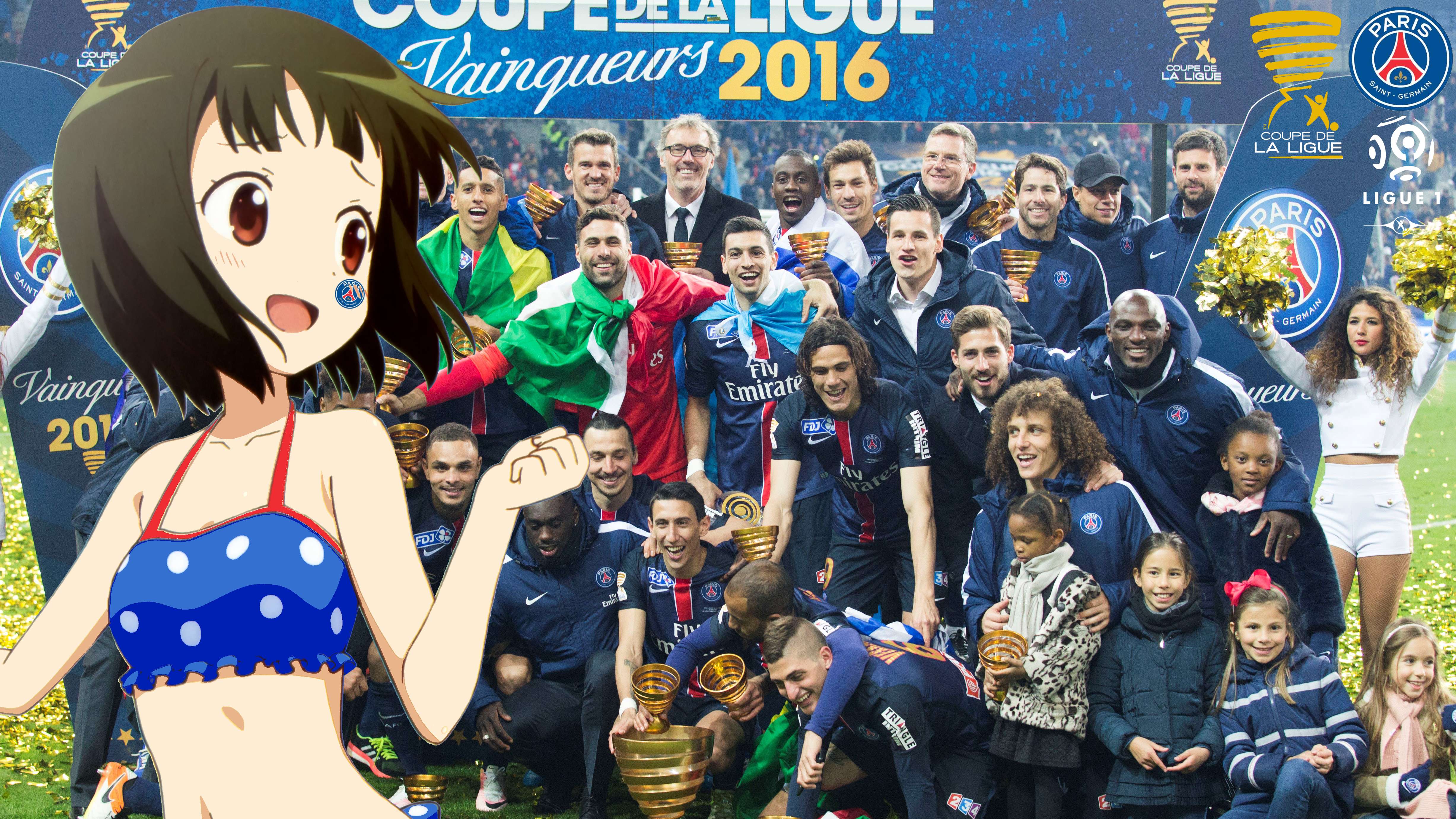
By winning their sixth Coupe de la Ligue trophy on Saturday, Paris Saint-Germain came the most decorated mens team in the history of French football! An incredible trophy haul for a club that celebrated its 45thanniversary at the beginning of the season… far behind Marseille (founded 117 years ago), Monaco, Saint-Etienne and Bordeaux (97 years) and Lyon (66 years).
The current Paris Saint-Germain CEO and Chairman is now ahead of his illustrious predecessor Michel Denisot (eight trophies), with 11 titles won since his arrival in 2011. Under the direction of Nasser Al-Khelaïfi, the capital club has won four Ligue 1 titles, one Coupe de France, three Coupes de la Ligue and three Trophées des Champions… with a chance to make it 12 titles when Paris take on Marseille in the Coupe de France final on Saturday, 21 May at 21:00 at the Stade de France.
He was already the most decorated coach in the club's history, after last season's historic quadruple, but on Saturday he claimed his tenth title with Paris even though he has only been in charge of the team since June 2013. The coach with four Ligue 1 titles with Paris now has four Coupe de la Ligue titles to his name after winning in 2009 with Bordeaux and in 2014 and 2015 with Paris, equalling Didier Deschamps' record (Monaco 2003, Marseille 2010, 2011, 2012).
Nicolas Douchez, Salvatore Sirigu, Maxwell, Thiago Silva, Gregory van der Wiel, Lucas, Blaise Matuidi, Javier Pastore, Adrien Rabiot, Thiago Motta, Marco Verratti, Ezequiel Lavezzi (who left for Hebei China Fortune in January) and Zlatan Ibrahimovic became the most decorated players in Parisian shirts. These thirteen players lifted the 11th title since their arrival at the club (four Ligue 1 titles: 2013, 2014, 2015 and 2016; one Coupe de France, in 2015; three Coupes de la Ligue: 2014, 2015 and 2016; and three Trophées des Champions: 2013, 2014 and 2015)! They pulled ahead of current assistant coach Zoumana Camara, who won ten titles as a Paris player (three Ligue 1 titles: 2013, 2014 and 2015; two Coupes de France: 2010 and 2015; three Coupes de la Ligue: 2008, 2014 and 2015; and two Trophées des Champions: 2013 and 2014).
1. Paris Saint-Germain / 29 titles: Cup Winners' Cup (1), Ligue 1 (6), the Coupe de France (9), the Coupe de la Ligue (6), the Trophée des Champions (5), the Intertoto Cup (1), Ligue 2 (1)
2. Olympique de Marseille / 28 titles: Champions League (1), Ligue 1 (9), the Coupe de France (10), the Coupe de la Ligue (3), the Trophée des Champions (2), the Champions Challenge (1), the Intertoto Cup (1), Ligue 2 (1)